

Leaders Don’t Experience Problems in Categories
Understanding Executive, Leadership, Life, and Mindset Coaching
One of the most common questions people ask when they begin exploring coaching is surprisingly simple:
What kind of coach do I actually need?
The coaching industry has created coaching categories for good reason. They help people understand the broad focus of different coaching approaches. They also help coaches communicate where their expertise tends to lie.
But there is something important that often gets lost in those labels.
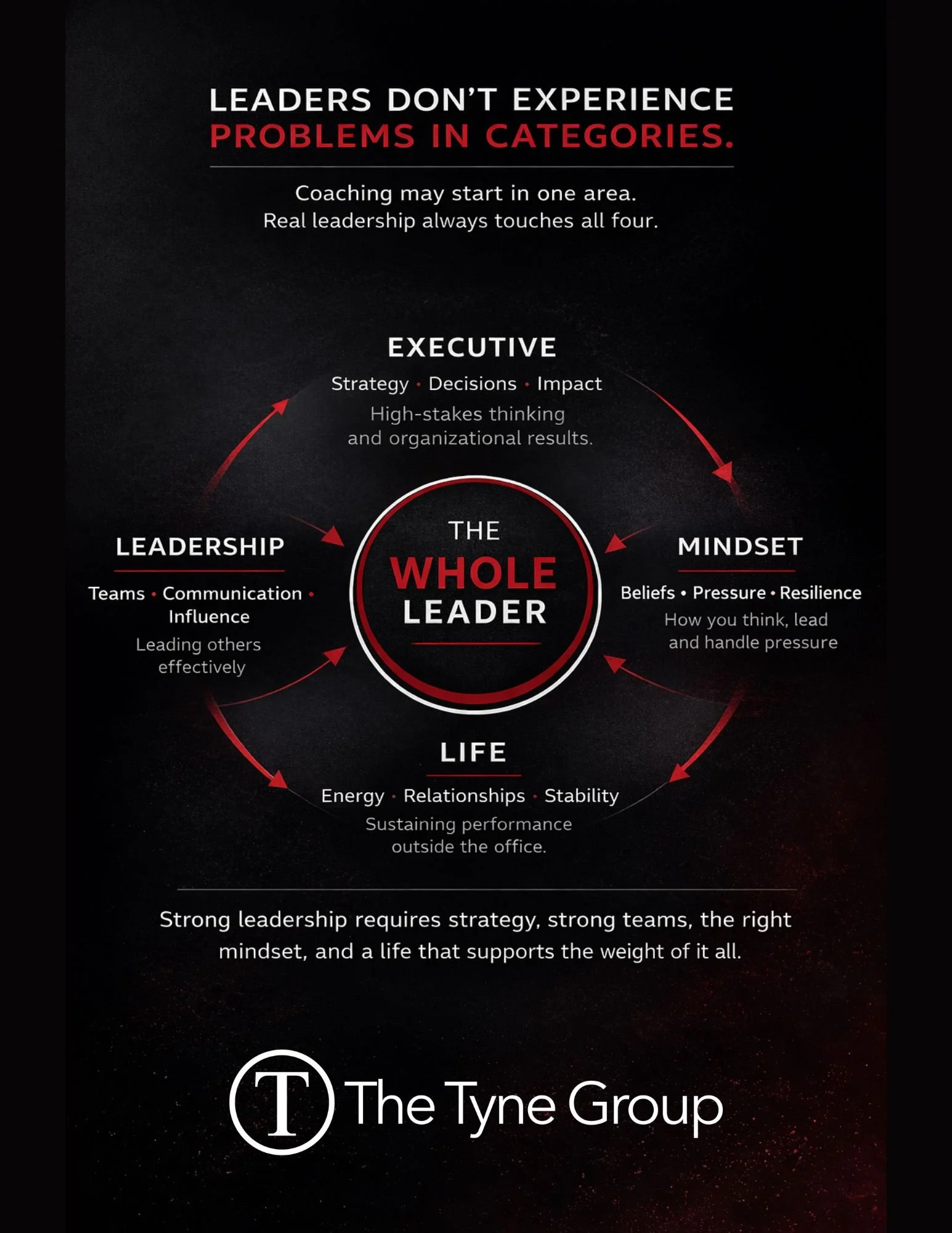
Leaders don’t experience problems in categories.
Real leadership challenges almost always sit at the intersection of multiple areas of a person’s life, thinking, and responsibilities. Coaching sessions may begin in one lane, but meaningful breakthroughs frequently emerge somewhere else entirely.
A client may begin a coaching session wanting to talk about a strategic decision. By the end of the conversation, we have uncovered a belief pattern that has been quietly shaping how they approach risk. Another leader may initially want help navigating a difficult conversation with a team member, only to discover that exhaustion and pressure outside the office are affecting how they show up as a leader.
The work rarely stays where it started.
A Coaching Conversation That Shifted Direction
Not long ago, a senior leader scheduled a session because he needed clarity around a major organizational decision. His company was preparing for a significant expansion, and the move would affect hiring, operational structure, and several hundred employees.
On the surface, this was clearly an executive coaching conversation. We began by discussing the strategic variables: growth projections, operational capacity, leadership bandwidth, and the downstream impact of different choices.
But about twenty minutes into the conversation, something shifted.
He paused and said, almost offhandedly, “The truth is, I think I already know what the right decision is. I just can’t seem to pull the trigger.”
That moment moved the conversation into a completely different dimension of coaching.
What followed had very little to do with strategy. Instead, we explored the internal pressure he felt about getting the decision “perfect,” the weight of responsibility he carried for the people in his organization, and the way a previous business failure years earlier was still influencing how he approached risk.
The strategic question was real and falls cleanly into the area of executive coaching. But the barrier was not strategic, it was mindset.
By the end of the session, he had the clarity he needed to move forward with the decision. But that clarity did not come from analyzing spreadsheets or debating operational models. It came from addressing the thinking that was quietly shaping how he approached leadership.
The Four Common Types of Coaching
While leadership challenges rarely stay confined to one domain, most coaching approaches tend to fall into four broad areas. Understanding these categories can help leaders determine where they might want to begin.
Executive Coaching
Works with senior leaders on high-stakes decisions, influence, and organizational impact. It’s about how they lead businesses, teams, and strategy at the top levels.
Leadership Coaching
Helps people become more effective leaders of others. Focuses on communication, decision-making, accountability, and building strong teams.
Life Coaching
Broad, personal-development focused coaching that helps people improve satisfaction in areas like relationships, habits, and personal goals.
Mindset Coaching
Targets the beliefs and mental patterns that shape behavior. The work is about identifying and changing the thinking that holds someone back.
Each of these categories represents a legitimate entry point into coaching. Many coaches specialize deeply in one area, developing expertise and methodologies designed for specific outcomes.
But the reality of wholistic leadership blurs these lines.
Why Leadership Issues Rarely Stay in One Lane
A leadership challenge that appears operational may actually be rooted in mindset. A conflict with a team member may reveal deeper communication habits or personal stress. Strategic decision-making can be influenced by beliefs about risk, identity, or responsibility that leaders may not even realize they are carrying.
Leadership is inherently human work.
And human challenges tend to be interconnected.
Consider a few common examples.
A leader struggling with delegation may initially frame the issue as a leadership problem. But the real barrier may be a belief that asking others to take ownership will burden the team.
An executive navigating rapid company growth may believe the challenge is strategic complexity. Yet the real difficulty may stem from exhaustion, family strain, or a lack of recovery time outside of work.
Another leader may seek life coaching because they feel dissatisfied or restless. As the conversation unfolds, it becomes clear that they are no longer aligned with how they are leading inside their organization.
In each of these cases, the coaching conversation begins in one category but inevitably touches others.
The Coaching Industry Debate
This interconnected reality also explains why the coaching industry itself can be somewhat divided.
Some coaching philosophies lean heavily toward personal development and introspection. Others emphasize structured executive frameworks and business strategy. Each approach has its place, and each serves different types of clients.
But occasionally these perspectives become polarized.
Some observers dismiss certain coaching styles as too abstract or “woo-woo” to be useful in professional environments. Others argue that traditional executive coaching models can become overly rigid, leaving little room for the deeper reflection that often drives lasting change.
In practice, effective coaching usually sits somewhere between those extremes.
Leaders benefit from clear thinking, strategic rigor, and structured decision-making. They also benefit from understanding their own assumptions, motivations, and internal narratives.
Both dimensions matter.
Finding the Right Coach
For leaders considering coaching, the question is often framed as:
What type of coach do I need?
Distinctions such as ‘executive coach’ or ‘leadership coach’ can be helpful. They give you a sense of where a coach typically focuses their work and what kinds of conversations they facilitate most often.
But the reality of leadership development is more fluid than those labels suggest.
Starting with a defined goal is both normal and productive. What many leaders discover, however, is that the conversation does not always stay confined to the original topic.
This is why effective coaching requires both focus and flexibility.
A coaching session can absolutely target a specific issue. But the work should also allow space to follow the insight wherever it leads. Sometimes that means exploring mindset. Sometimes it means revisiting leadership habits. Occasionally it means acknowledging the broader life context that affects how someone shows up every day.
The best coach for any client is one they trust. And the best coaches know and reflect through their coaching that…
The leader is always the center of the work.
March 2026